Training Your German Shepherd Puppy
There’s allot more benefit to training your new German Shepherd puppy than getting him to poop outside. You see, by training your new puppy correctly, what happens because of your roll as trainer, you also are establishing your role – and his – as members of the pack. You are the pack leader, and your new dog is a member within that pack.
I’ll give a brief step by step guide to training the German Shepherd puppy you’ve just brought home, starting with the basics.
Step #1 – Kennel Training
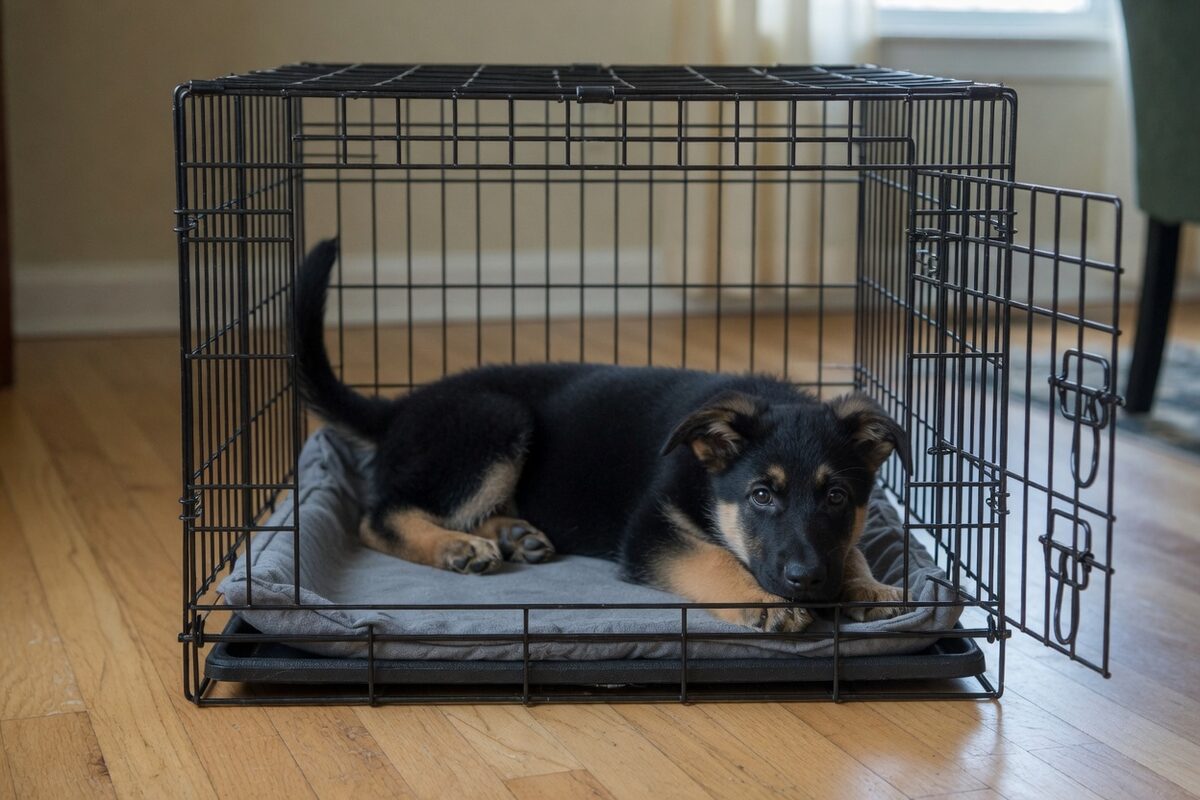
Here’s your new pup, loving you up and wanting to explore your home. He looks so cute, doesn’t he? Now what is he getting into now? Oh oh, he’s chewing on an extension cord! Now he’s using your new $100 pair of shoes as a chew toy!
This type of behavior is kind of cute when your new puppy is 8 weeks old, but what about when he turns 1 year, and still has a problem with chewing on electric cords? Not so cute, right? Well, to lessen these types of mishaps, and to also ease your house training efforts, I recommend the (effective use of…) an indoor kennel. Keeping “fido” in his kennel while he sleeps will give you piece of mind. Also, keeping him in it while you do your thing is something I also high recommend.
You see, to fully understand your new dog and dog behavior in general, you have to go back to basics. And basically, your dog is not a human. He’s a canine that has genetically programed behaviors that we can use to our advantage. Why is this important? Well, for many who get a dog as a companion, the way they relate to their dog is the same way they relate to other humans. But with dogs, they can understand very little about our emotional decisions. They run off pack drives. These pack drives (genetically hard-coded behaviors) are how dogs relate to the world, to other canines, and to us.
And one of these pack drives is the need for a den. You see, your new dog will feel more comfortable in a kennel – their new “den” – very soon. They’ll see their kennel as their own private space (den), and will readily get into it with a simple command, “kennel!”.
Step #2 – Tethering
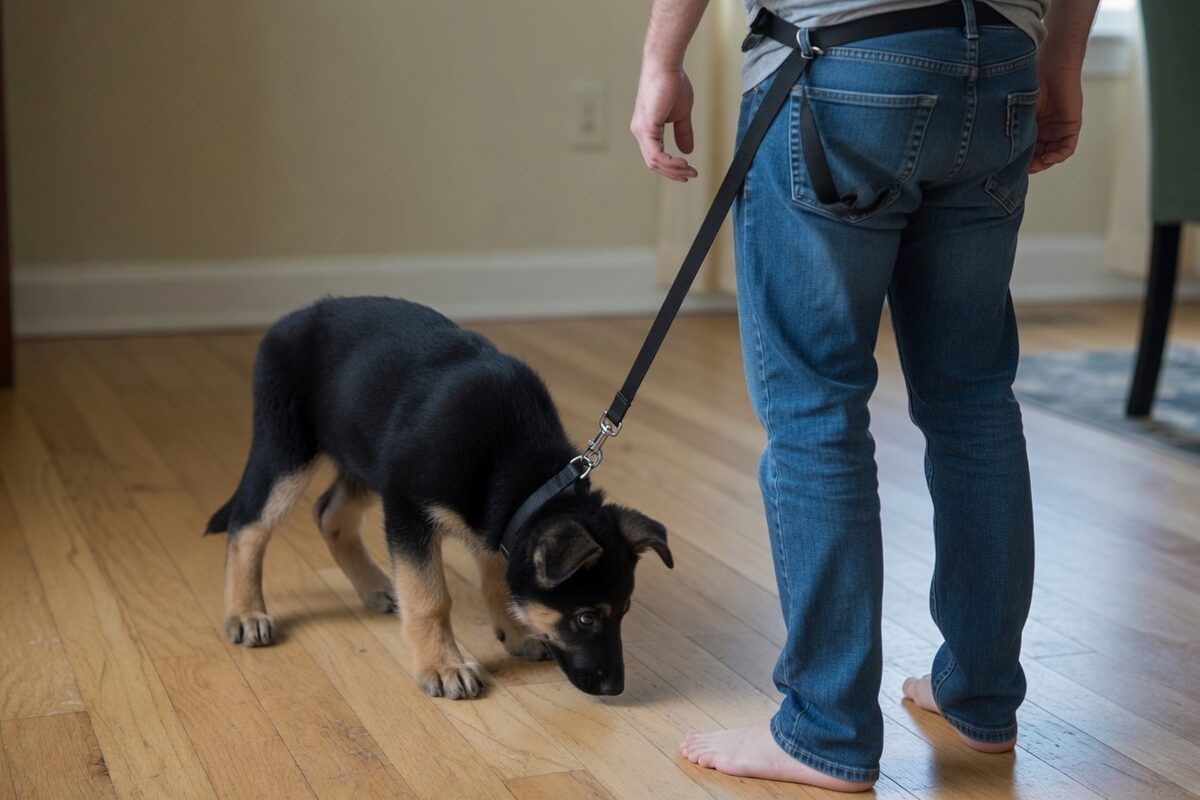
What I typically do with new puppies is a technique called “tethering”. Basically what I do is get them used to a collar and leash, all the while looping the leash around my waist. The new pup has no alternative but to find total fun, food, and exploring all the while no further than 6 feet away from me – wherever I go. This creates an instant bond. It actually accelerates the bonding time that a pup will have with their new owner.
This bond will be life-long.
Step #3 – House Training
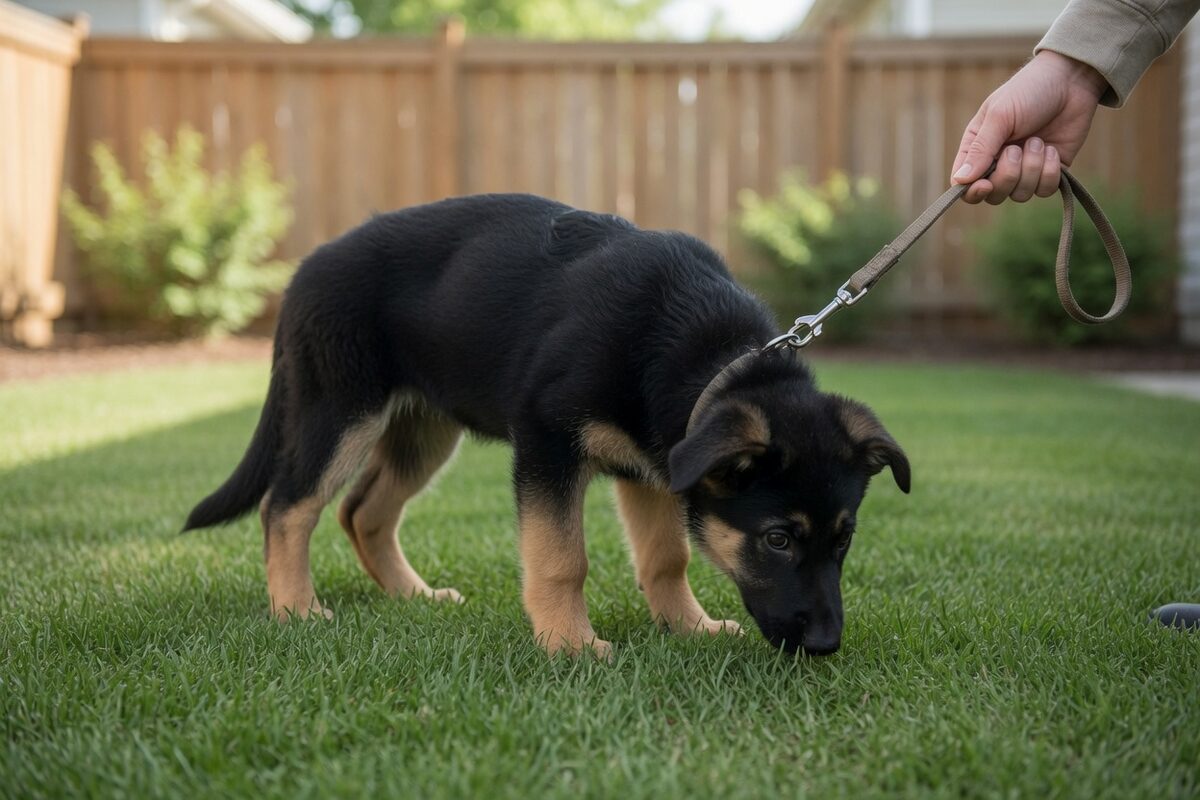
Remember those $100 shoes? House training is the other half of that story. A puppy with the run of the house will find a quiet corner, make it his bathroom, and be very proud of himself. You will not be. The kennel from step one, and the leash around your waist from step two, are how you stop that before it turns into a hobby.
You see, dogs are clean animals. One of those pack drives is that they try not to soil the den they sleep in. That’s why the kennel works, if you size it right. Big enough for him to stand up, turn around, and lie down. No bigger. Give him a ballroom and he’ll pee in one end and nap in the other, perfectly happy, while you wonder what went wrong. Nothing went wrong. You gave him a spare bathroom.
So here’s what I actually do. A pup about 8 to 12 weeks goes out the second he wakes up, and again right after he eats, drinks, or plays. Leash on. Same spot every time. I don’t stand there chatting about the weather. I wait. The second he goes, I mark it – “YES! Good potty!” – and then we head back in. If nothing happens, back in the kennel or back on the tether, and we try again shortly. At that age I’m taking him out about every 20 minutes while he’s up and with me. Once he’s gone, he can settle in the kennel for a bit. By 4 to 6 months you can stretch toward every couple of hours. From about 7 months to a year, a lot of them can hold it around 4 hours. My adult shepherds go much longer than that. Your puppy is not an adult shepherd yet, no matter how big his feet already are.
While he’s tethered to you, watch the tell. Circling, sniffing hard, suddenly walking away from the fun – that’s your cue, not his. Get him outside before the show starts. If you catch him mid-squat in the house, a quick “Nein!” (that’s “no”) and straight out the door. If he finishes outside, that’s the behavior you pay. If you come home to a cold puddle, you already missed it. Yelling at a puddle trains him to be nervous about you, not about the rug. Clean it up so he can’t still smell the invitation, and set the next trip up better. Real babies also mean a middle-of-the-night alarm. I’ve set plenty of them. Not cute. Works. I also pick the water bowl up in the evening, after he’s had his fill, so we’re not running a pee marathon at 2am. He still drinks with meals and through the day. And if he’s suddenly going constantly, or soiling the kennel and then laying in it, that’s a vet visit. That’s not “being stubborn.”
Step #4 – Sit
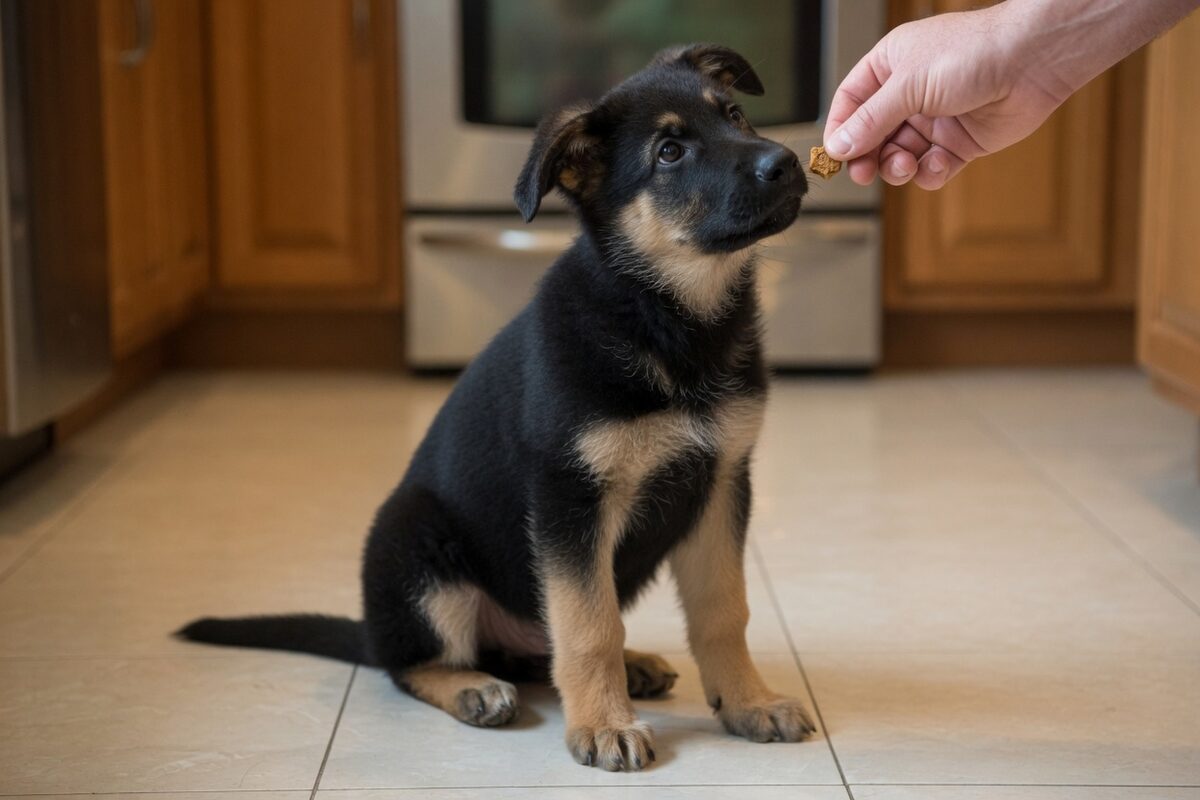
Sit is the first real job you give him. Puppies can learn it stupidly young – I’ve started them around 6 weeks. Don’t yell it across the room while he’s in the middle of a shoe. He doesn’t speak English yet, and volume is not a translator. (I’ve yelled “Sit! I said sit, dang it!” at a dog before. It did not make me the pack leader. It made me loud.)
What I do is lure it. Puppy in front of me, a tiny treat at his nose, and I move that treat up and slightly back over his head. His nose follows. His butt hits the floor. The very second that butt lands, I say “YES!” and then “Good sit!” and he gets the treat. That’s my marker. Same idea as a clicker, except my hands are already full of puppy. You name it while his body is doing it. One word. Same word. Every time. Not ten times while he’s still standing there thinking about it.
Keep it short. A handful of reps, then go play, or back to the tether and just be a puppy. His brain taps out fast. Yours will too, if you turn this into a half-hour lecture. Once he offers the sit easy, he starts earning the good stuff with it. Sit before the food bowl goes down. Sit before the leash clips on. Sit before the love-fest. Nothing in life is free, and sit is how a puppy pays rent. I teach my German Shepherds the German later – “Sitz,” sounds like “siitz” – because it’s handy once we get into real obedience. Pick one language and stay there. “Sit… Sitz… SIT” is three commands and zero clarity.
And since I’m the pack leader and not a bully: this is the learning part. No jerking the leash. No shoving his butt to the floor. No prong collar on a baby who doesn’t know the word yet. If he misses, you just reset the lure and try again. Corrections come way later, after he knows it cold and decides a distraction is more interesting than you. That’s a different phase, and I wrote it up over in basic training. For now it’s the kitchen floor, a treat, a YES!, and you’re done.
Step #5 – Down
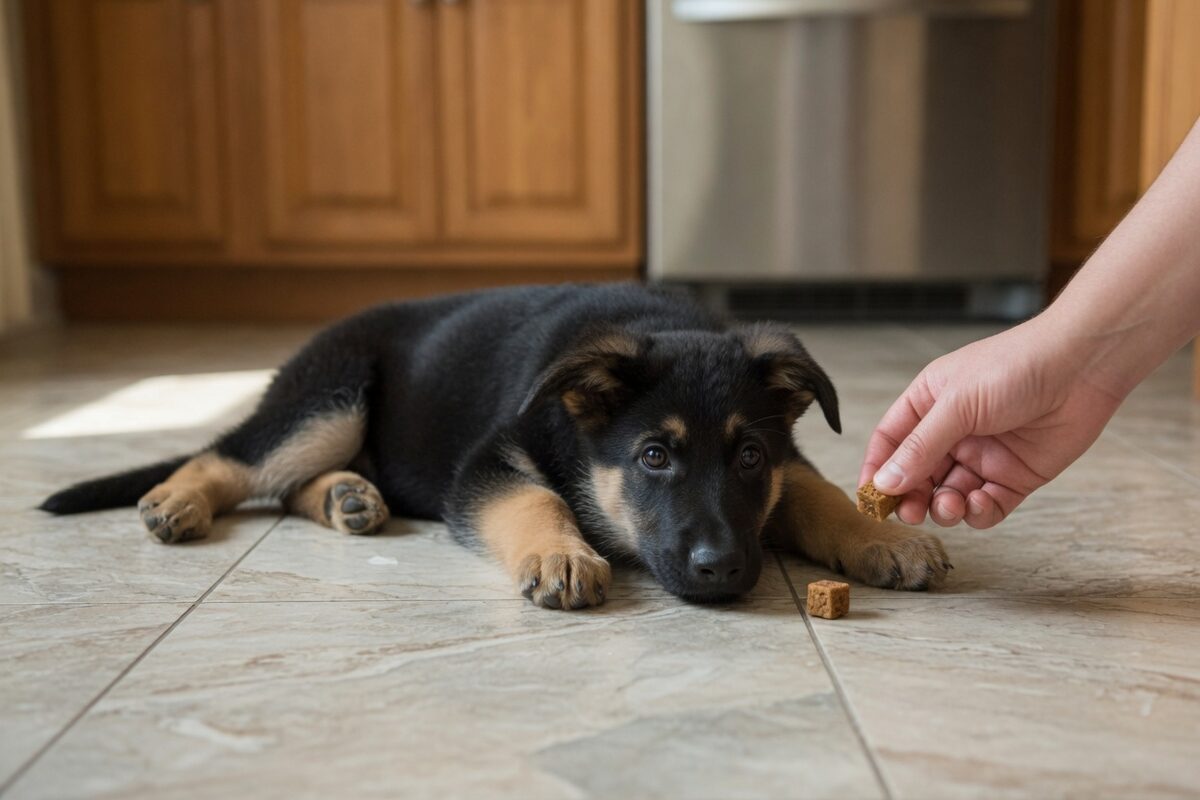
Down is sit’s calmer, more serious cousin. I don’t start it until sit is easy, because down asks more of him. Belly on the floor is a vulnerable spot for a dog. It’s him trusting that the pack leader asked for a relaxed body, not a wrestling match. That’s why you never mash a puppy into a down. You show him. You pay him. He figures out the floor is a pretty good deal.
From a sit, I take the treat at his nose and draw it slowly toward the floor, between his front paws, or slightly back toward his chest. Most pups fold. Elbows hit, tummy hits, and right then – not after he pops back up – I mark “YES! Good down!” and I pay that treat on the floor. Pay it up by your face and you just trained a very athletic sit. If he won’t fold, and he just keeps standing on his head, try a slick kitchen floor, or lure him under your leg or a low chair so the easy path is down. Still no pushing. Patience. A few reps. Quit while he still thinks you’re fun.
Same rules as sit. Short sessions. One word. With my shepherds I use “Platz” once we’re working for real (German for down, sounds like “plots”). You can say “down” if that’s the language of the house. Just don’t use both. Then actually use it. Down while you eat dinner, so he isn’t lobbying for scraps like he pays the mortgage. Down before a guest gets to say hello. Down at the door, and you go through first. A down you only get when he’s already tired is not a command. It’s a nap that happened to look obedient.
Once sit and down are boring in the kitchen, take those same commands outside and treat them like brand new ones. The yard has smells. The park has opinions. That’s the next chapter, over in outdoor obedience. The bond you started with the kennel and the tether is the same bond that makes a down mean something. You asked. He did it. You paid it. That’s the whole job.